
The American Dream has always rested on a simple premise: if you own your land and follow the rules, you can create something that lasts—not just a building, but a livelihood, a community, and a future. That premise depends on one condition above all others. The law must be applied as written.
Jim Griset tested that idea in Prescott, Arizona. What happened next revealed just how fragile property rights and equality under the law can be.
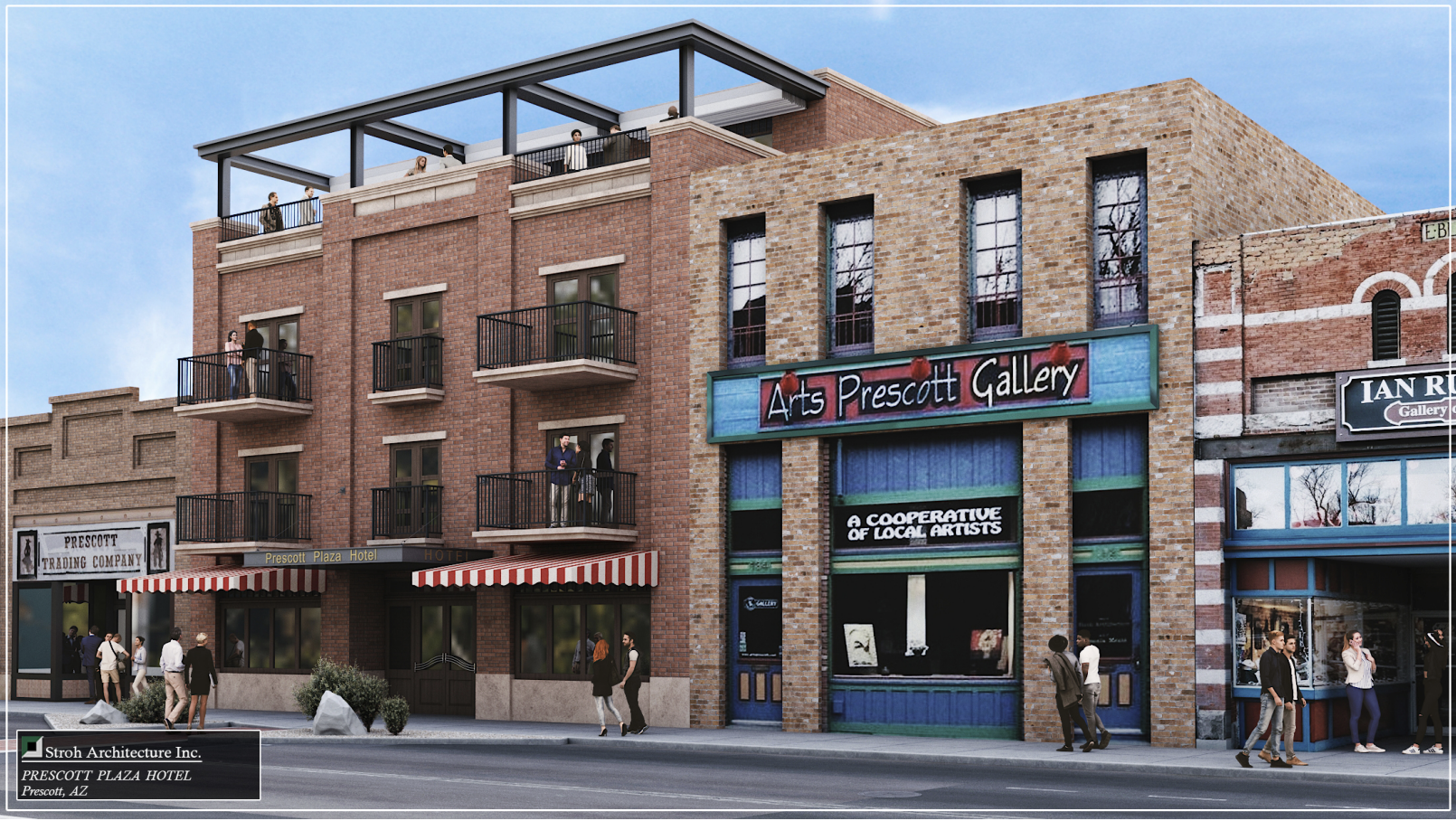
Griset owns three buildings on Whiskey Row, the historic downtown corridor that has defined Prescott's identity for over a century. His plan was straightforward: replace aging, underused structures with a boutique hotel designed to complement the district's character, attract visitors, and contribute to the local economy. He submitted his application to the city's Historic Preservation Commission, revised his plans in response to feedback, reduced the building's height, scaled back the number of rooms, and incorporated public input at every stage.
None of it was enough. Each time Griset met the stated objections, new ones materialized. Standards appeared after the fact and requirements shifted midstream. Whether by design or dysfunction, the effect was the same: a process with no discernible endpoint.
The selective nature of that treatment became harder to ignore when it emerged that the city itself had sold its old City Hall to a developer building a four-story hotel in the same historic district without the resistance or shifting standards that Griset faced. If historic preservation was the principle at stake, it was being applied with remarkable inconsistency.
The commission, for example, rejected his application not on the basis of any codified standard, but on subjective impressions: whether the design was sufficiently "respectful" of the district's "intimate scale," whether the new construction would be adequately "subordinate" to its surroundings. These are rhetorically appealing phrases rather than legally defined standards. As Jon Riches, Vice President for Litigation at the Goldwater Institute, later told the Prescott City Council while speaking on Griset’s behalf, the commission was relying on "vague, subjective impressions" untethered from any provision of city code or Arizona statute.
Riches would know. The Goldwater Institute helped enact the state's Permit Freedom Act precisely to prevent this kind of abuse. The law requires cities to base permitting decisions on clear, objective, and pre-existing criteria. Local governments cannot invent new requirements as projects go along or enforce vague impressions that appear nowhere in enforceable code. Working with Griset, Goldwater attorneys argued that what Prescott had been doing was not merely unfair—it was illegal.
Property rights are not merely about ownership. They are about certainty. When the rules are clear, investors can plan, build, and take risks with confidence. When the standards shift, ownership becomes conditional and the foundations of our freedom and democracy begin to erode. As Riches put it, that kind of arbitrariness "invites uncertainty" and "undermines trust in local government." It also makes Americans poorer because, over time, uncertainty discourages the very investment that communities depend on.
After Goldwater attorneys highlighted the city's legal obligations under the Permit Freedom Act, the City Council ordered an independent review by an outside historic preservation expert. That neutral assessment confirmed what Griset had argued from the start: his project met every objective criterion in the city's Historic Preservation Code. Despite this finding, the Historic Preservation Commission voted 3-2 to deny the project again.
Griset appealed. Goldwater attorneys warned the City Council that there was no legal basis for denial and that proceeding without one would expose the city to liability under the Permit Freedom Act.
In November 2025, the City Council reversed the commission's decision. Several council members later spoke openly about the importance of private property rights and the need for fair, consistent criteria rather than standards driven by subjective preferences or political pressure. The reversal was narrow and practical, but it also carried a broader conclusion: In Arizona our rules are anchored in the law.
Local governments have legitimate interests in creating vibrant communities, and especially preserving the health and safety of neighbors and residents. Neither of those concerns empowers bureaucrats or elected officials to simply veto projects they don’t care for. The Permit Freedom Act drew that line, and the Goldwater Institute will continue to enforce its requirements of timeliness and equal application of the law.
The result is a legal framework that gives people like Jim Griset the confidence to invest, helping keep Arizona among the fastest-growing states in the country.
The American Dream relies on predictability and fairness in the law. It allows individuals to plan, invest, and build with the expectation that the standards governing their efforts will be applied as written. Without that certainty, the dream becomes a gamble—one dependent on who holds power. Americans have long understood that laws work best when applied equally. That understanding is not self-sustaining and must be defended, as it was in Prescott. A nation of builders cannot endure being governed by whims.
When the rules change, so does your freedom. The Goldwater Institute ensures that government follows the Arizona Permit Freedom Act—ensuring that government follows clear, objective rules rather than shifting standards.
If your project, permit, or property has been caught in bureaucratic overreach, the Goldwater Institute wants to hear from you. Visit https://www.goldwaterinstitute.org/submit-a-case/ or email caseinquiry@goldwaterinstitute.org.
Donate Today
Fill in the form.
